

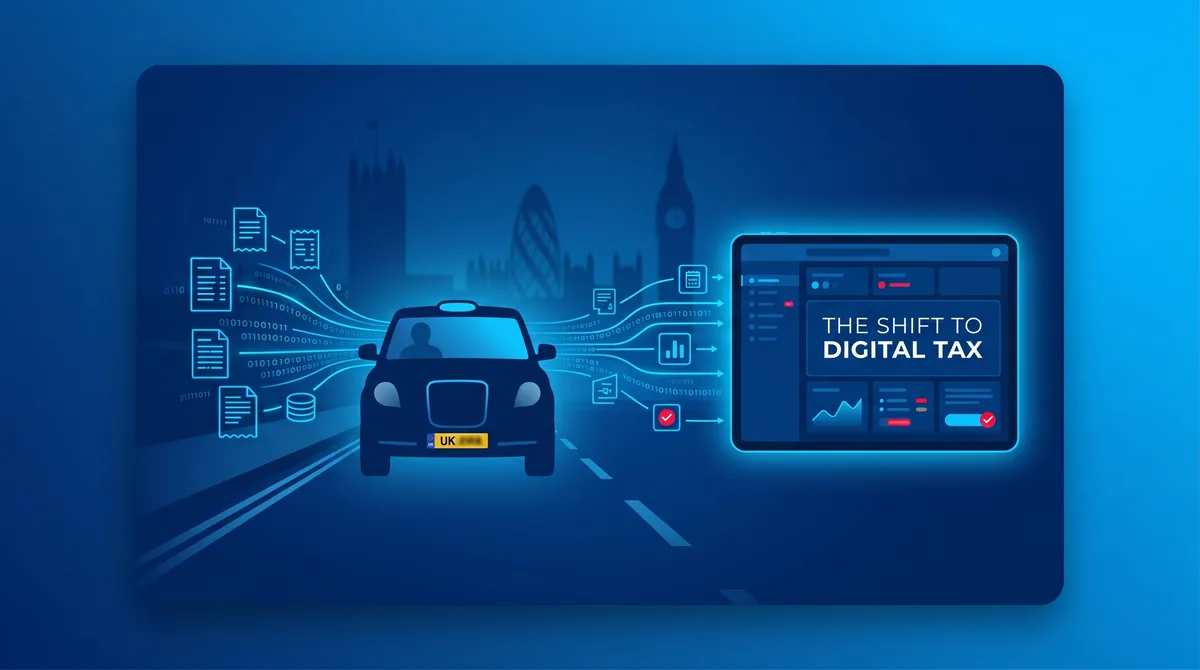
The shift to digital tax in the UK - what it means for drivers
If you drive for a living in the UK - taxi, private hire, or through platforms like Uber - the tax system around you is changing. Not with a single announcement, but through a series of small shifts that add up. You might not notice it in one day. But over time, it changes how the job feels.
For years, self-employment worked at a distance. You earned money through the week, paid for fuel, covered the usual costs, and kept a rough sense of how things were going. When tax season came, you sat down and turned that activity into numbers. Sometimes carefully, sometimes approximately. It wasn’t perfect, but it worked because the system allowed it.
You could fix things later.
That is the part that is disappearing.
With changes introduced by HM Revenue & Customs - especially Making Tax Digital - the system is moving away from that yearly reconstruction. It no longer assumes you will build your numbers at the end. It assumes they already exist.
The final number still matters.
But now the system also cares how you got there.
For drivers, this lands in a very specific place - in the way the work actually looks. A typical week doesn’t produce neat accounts. It produces fragments. Dozens of trips, small payments adding up, fuel that changes week by week, and costs that arrive when they arrive. A tyre, a service, a licence renewal. Nothing about it is naturally tidy.
In the past, that didn’t matter much. You could step back from the detail and shape it into something that made sense. If something was missing, you filled the gap. If something didn’t line up perfectly, you adjusted it. The system tolerated that kind of approximation.
Now it tolerates it less.
This doesn’t show up as a dramatic change. It shows up in small moments. When you realise that guessing your fuel costs at the end of the year is no longer enough. When your monthly figures need to make sense on their own, not just as part of a total. When the same numbers start to be looked at more than once, in different contexts, and need to hold together each time.
It’s not that you’re doing more work.
It’s that the work can’t be delayed in the same way.
Take a simple example. You have a week where you earn £1,100. Fuel takes £250. Platform fees and other costs take another £200. In the old model, you might just remember the £1,100 and deal with the rest later. When the year ended, you would sit down and work out what was left.
Now that gap matters.
Because what the system increasingly cares about is the number underneath - what remains after everything is taken off - and whether that number is supported by something real. Not just a memory, but a record that exists at the time.
That is where the shift becomes practical. Not in the rules themselves, but in how close your records sit to your actual work.
From the outside, the logic is straightforward. A system built on estimates and late adjustments creates errors. A system built on ongoing, structured data reduces them. Less guesswork. More consistency. Fewer surprises at the end of the year.
From the driver’s side, it feels different. It feels like a reduction in flexibility. The ability to leave things incomplete and return to them later becomes less useful. The system assumes you are keeping up. And if you are not, catching up is harder than it used to be.
This is where many drivers feel the pressure first.
Not because the rules are impossible, but because they don’t match the habits that worked before. The instinct to “sort it out later” doesn’t disappear overnight. But the system stops accommodating it. And that’s the point where friction appears - not as a single problem, but as a series of small ones that build up.
At the same time, something else becomes clearer. When your records are up to date, you don’t have to guess your position. You can see it. What you earned, what you spent, what is actually left. That removes a different kind of pressure - the uncertainty that builds when you know you’ve been working, but don’t quite know what that means financially.
So there is a trade-off.
You gain clarity.
You lose flexibility.
For drivers, this balance is sharper than in many other types of work. The income is fragmented, the costs are uneven, and the margin between them is what really matters. When that margin is visible, things become simpler. When it isn’t, everything becomes harder.
Looking ahead, the direction is unlikely to change. Thresholds for systems like MTD are already dropping - from £50,000 to £30,000, then to £20,000 - bringing more drivers into the same structure. What starts as a requirement for some becomes standard for most. Not overnight, but steadily.
And once it becomes standard, it stops feeling like a special rule. It becomes the way things are done.
In that context, the practical response is simpler than it looks. You don’t need to build a complex system. You only need to reduce the distance between the work and the record. Instead of leaving everything to the end of the year, you bring a small part of it into the week. Income is noted when it happens. Costs are recorded when they occur. The overall picture builds itself.
That is enough.
For drivers who make that shift early, the change becomes almost invisible. It doesn’t feel like extra work. It feels like a different rhythm. For those who don’t, it feels like the system is pushing back, when in reality it has simply moved forward.
The difference is not effort.
It is timing.
And that is where tools like TaxiManager fit. Not by adding more accounting, but by removing the need to reconstruct anything later. When income, expenses, and profit are already organised as part of the work itself, changes in reporting don’t force you to adapt. They simply use what is already there.
In a system that is becoming less tolerant of delay, that quiet alignment is what makes the difference.
Further reading
- MTD thresholds explained (2026–2028) - who is in scope and when
- Taxi driver accounting software (UK) - what actually works for drivers
- Start your free trial on TaxiManager