

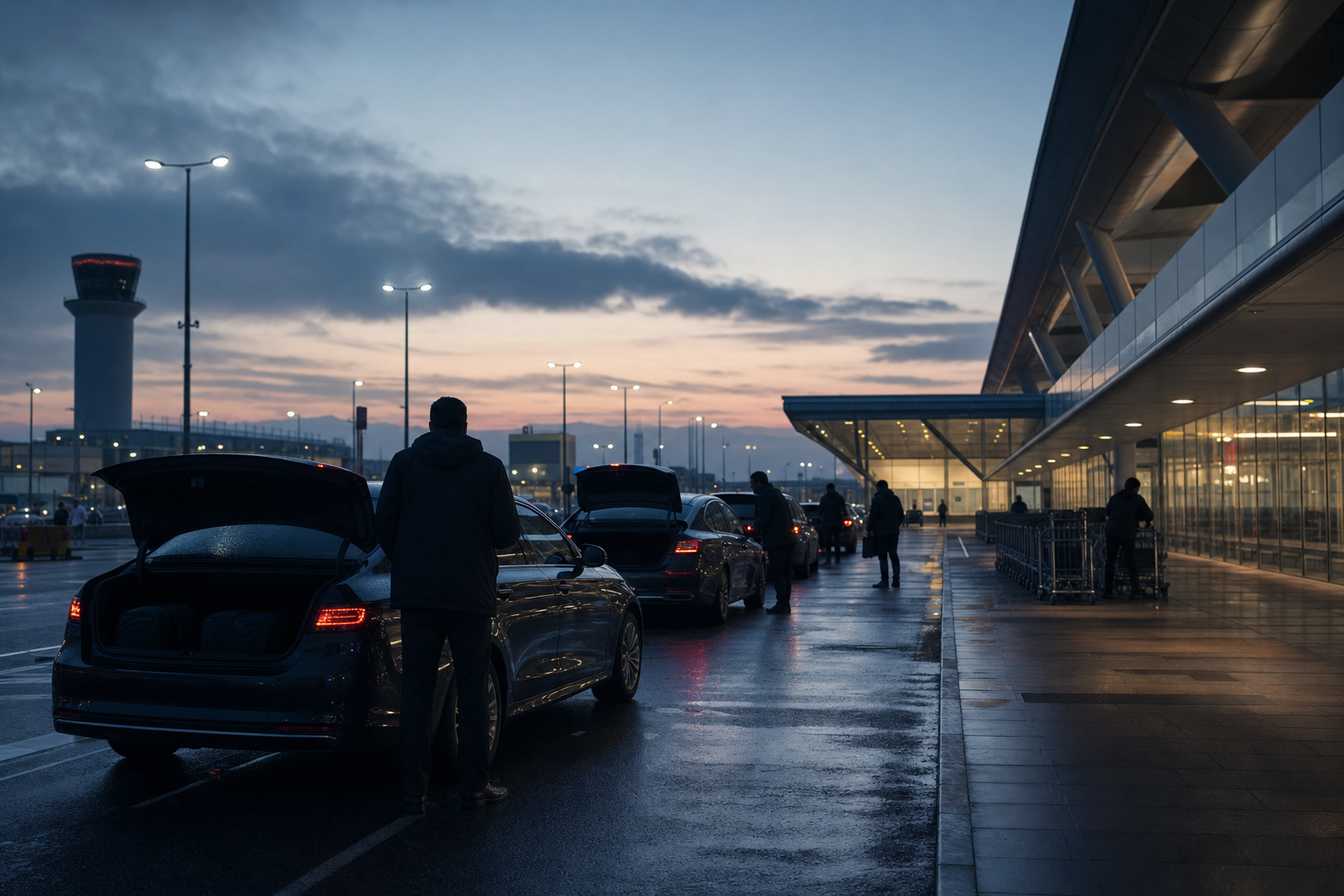
Sunday Morning at Heathrow
At Heathrow, Sunday morning begins before most of Britain has decided whether to get out of bed.
The first arrivals come through under white terminal lights, carrying duty-free bags, tired children, neck pillows, and the mild confusion of people whose bodies believe it is still somewhere else.
Outside, a line of private hire cars waits in the cold.
The drivers have already been awake for hours.
Before Britain wakes
Some came down the M1 in darkness. Some slept badly in Luton, Slough, Hounslow, or a rented room further east.
One has been circling the airport since half past four because the app sent him too early and the holding area charges by the minute. Another is drinking coffee from a paper cup with the concentration of a chemist handling volatile material.
Airports are sold as gateways. For drivers, they are systems of queues.
There is a queue for the passenger, a queue for the pick-up zone, a queue to leave, and often another queue on the motorway when everyone finally escapes at once.
Between them sit flight delays, parking fees, app messages, passengers standing at the wrong terminal, and the mysterious confidence of people who write “I’m outside” while still waiting at passport control.
The driver waits because waiting is part of the fare, though rarely the profitable part.
He checks the arrivals board. Then WhatsApp. Then the app. Then the arrivals board again, as if the aircraft may have reconsidered its route over Belgium.
The car park republic
Around him, the airport car park has built its own small society.
Men recognise one another by car before name. A silver Prius from Birmingham. A black Mercedes from Reading. A Toyota with 240,000 miles and an owner who insists it has “just been run in.”
They exchange the useful intelligence of the trade.
Terminal 3 is chaos.
The M25 is moving.
Police are checking the wrong lane.
Do not take the tunnel.
A flight from Islamabad has landed early.
A flight from Bucharest has not landed at all.
This information moves faster than anything issued by the airport itself.
Nobody formally organised this network. It formed because official systems describe what should happen, while drivers need to know what is happening now.
By seven, the terminals begin to spill families.
There are grandparents arriving for long visits, students returning with too much luggage, business travellers already making calls, and couples who have survived a ten-hour flight only to begin arguing beside the trolley bay.
A driver lifts two suitcases into the boot. The passenger asks whether there will be traffic.
There will always be traffic.
He gives the professional answer instead.
“Should be fine this morning.”
The road out
The destination is Leicester. Good fare, long return.
The passenger may sleep for most of it. The driver will not.
On the motorway, Britain gradually wakes up. Service stations fill. Church car parks open. Families begin the Sunday journey to somewhere they did not want to visit during the week.
The driver moves through all of it, visible and unnoticed.
This is the peculiar position of the trade. Drivers enter thousands of private moments without becoming part of them.
They collect people after funerals, weddings, hospital appointments, missed flights, first dates, final arguments, and nights nobody will explain in daylight.
They hear conversations in fragments.
A daughter tells her mother she is pregnant.
A man whispers that the deal is finished.
Someone in the back seat says:
“Do not tell Dad yet.”
The driver keeps his eyes on the road.
Discretion is one of the industry’s oldest services. It rarely appears on the receipt.
A welcome committee of one
By late morning, the airport has changed character.
The red-eye exhaustion has softened into Sunday travel. Children press their faces to terminal glass. Families wait with flowers. Drivers stand beside cars holding names on phones, each one briefly representing a welcome committee of one.
Some passengers will complain about the price.
Some will ask how long the driver has lived in Britain, then seem surprised when the answer is twenty-three years.
Some will ask where he is “really from” while being driven to a house he could never afford in a city he knows better than they do.
The driver has heard every version.
He answers according to mood.
Around noon, the man from the rented Toyota finishes his Leicester run.
The app offers him another job immediately.
He looks at the distance, the fare, and the route home.
Then he accepts.
The people who get everyone home
This is how Sunday moves forward.
One arrival at a time. One boot full of luggage. One tired person collecting another tired person and carrying them across the country.
Airports get the architecture, the uniforms, the departure boards, and the photographs.
The drivers get everyone home.
Further reading
- Britain Runs on Migrant Drivers - who keeps the UK taxi and private hire trade moving
- TaxiManager Guides - practical help in the languages drivers use when decisions matter
Keep your income, costs, and records in one place.
TaxiManager is built for UK taxi and private hire drivers.
Start your free trial