

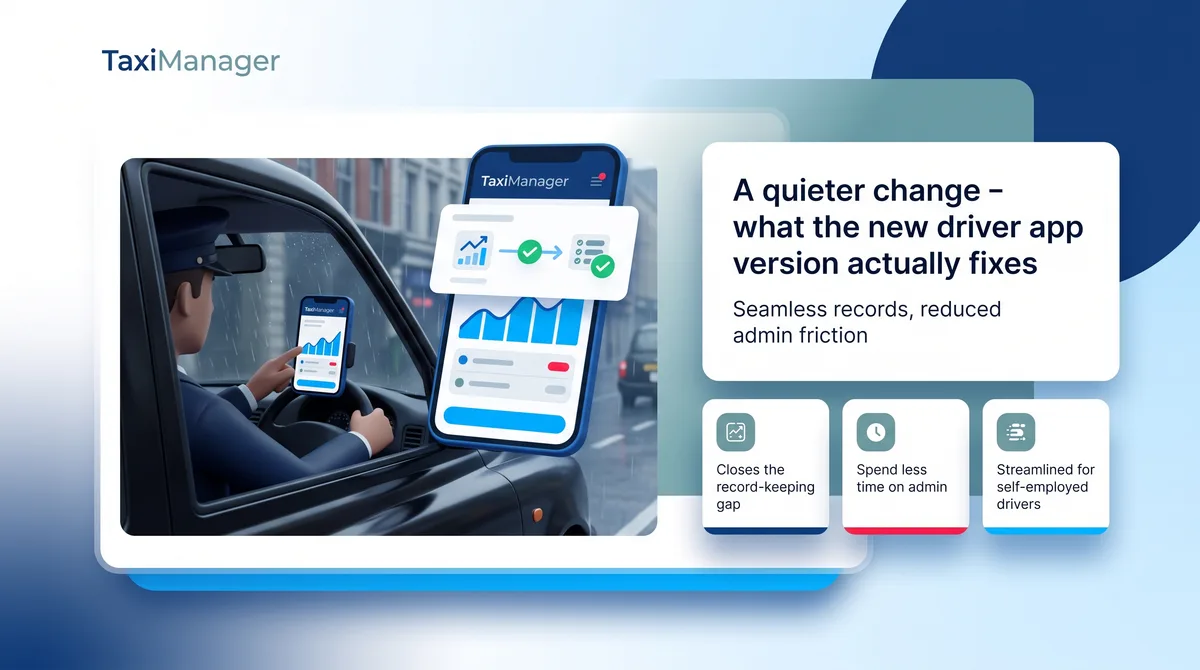
A quieter change - what the new driver app version actually fixes
Software updates are usually described in terms of features. New buttons, new screens, new capabilities. But from the driver’s point of view, that’s rarely what matters. What matters is whether something that used to take effort now happens more naturally, or doesn’t need to be done at all.
The new version of TaxiManager wasn’t built to add more things to do. It was built to remove a specific kind of friction that most drivers have learned to live with - the gap between doing the work and recording it.
If you drive regularly, you know how that gap appears. The week moves quickly. Trips blur into each other. Fuel gets paid, small costs come and go, and at the end of it you have a general sense of what happened, but not a clean record of it. You tell yourself you’ll sort it out later, when you have time, when things slow down. And sometimes you do. But often, that “later” turns into a larger task than it needed to be.
That pattern worked well enough when everything was built around a single moment of reporting. You could afford to let things accumulate. You could reconstruct. But as the system around you shifts towards more regular, more structured reporting, that delay becomes the main source of difficulty.
The new version of TaxiManager is built around that exact point.
Instead of asking you to sit down and “do your accounts”, it tries to make the record part of the work itself. Not perfect, not complete in one go, but present. Income is already there in a form that makes sense. Expenses are not something you have to remember; they are something you recognise as they happen. The difference is small at the level of a single entry, but it compounds over time.
A week where everything is roughly captured feels very different from a month where everything needs to be reconstructed.
One of the changes you’ll notice first is how little you need to think about structure. In older workflows, even simple tracking required decisions - where to put something, how to categorise it, whether it counted as this or that. Those decisions slow things down. They make it more likely that you postpone the task entirely.
Now, the structure is already there. Fuel is fuel. Commission is commission. Licence fees sit where you expect them to sit. You don’t have to build the system each time you use it. You step into one that already matches how the work looks.
That sounds minor, but it changes behaviour.
When something is easy to record, it gets recorded. When it requires a moment of thinking, it often gets delayed. Over time, that difference is what separates a clean, usable set of records from something that feels like a problem waiting to happen.
Another change is visibility. Not in the sense of more charts or more data, but in the sense that the number that actually matters - what you have left after costs - is always there. Not estimated, not reconstructed, but simply visible. That changes how you think about your work. It stops being about how much you earned in total, and becomes about what that work is actually producing for you.
For many drivers, that is the first time the numbers feel stable.
This becomes more important as reporting expectations change. With systems like Making Tax Digital introduced by HM Revenue & Customs, the pressure is not just to report, but to be ready to report. That readiness doesn’t come from doing more work at the end. It comes from not having to catch up at all.
The new version of TaxiManager is designed with that in mind. Not as a response to a single requirement, but as an adjustment to the way the environment is evolving. More frequent reporting, less tolerance for gaps, more emphasis on consistency. None of that requires complexity from the driver’s side, but it does require a different rhythm.
And that rhythm is what the update is really about.
You don’t notice it in a single day. You notice it when a week passes and there’s nothing to fix. When a month ends and the numbers already make sense. When something that used to feel like a task becomes part of the flow of the work.
That is the change.
Not more features.
Less catching up.
And over time, that difference is what makes everything else - tax, reporting, even just understanding your own income - feel simpler than it used to be.
Further reading
- The shift to digital tax in the UK - what it means for drivers - how HMRC’s direction changes what “good enough” records look like
- MTD software for taxi drivers - the full picture on structured reporting and tools
- Start your free trial on TaxiManager